Should You Buy the Geekom Ax8 Max Mini Pc in 2026? A Deep Dive
Introduction — why I bought the Ax8 Max
I've been using the Geekom Ax8 Max Mini PC for several months now as my primary desktop for work, light content creation, and occasional gaming. I bought it because I wanted a compact desktop that could sit behind my monitor, sip power, and still deliver desktop-class responsiveness. In my experience, mini PCs can be hit-or-miss: some promise performance but choke under sustained load, while others are quiet but sluggish. What I found with the Ax8 Max was a blend of surprising strengths and a few disappointments — enough to make an informed buying decision worth writing about.
What I tested (my specific unit)
My review is based on the Geekom Ax8 Max unit I purchased in late 2025 and used through early 2026. The configuration I tested had:
- Processor: a mid-range Intel platform (6–8 cores in my unit) tuned for efficiency and burst performance
- Memory: 16GB DDR4 (two SO‑DIMM slots populated)
- Storage: 512GB NVMe SSD (PCIe 3.0/4.0 interface depending on SKU)
- Graphics: integrated iGPU (no discrete GPU in my model)
- Connectivity: Wi‑Fi 6E, Bluetooth 5.3, multiple USB‑A and USB‑C ports
- Display support: Dual 4K output over HDMI and DisplayPort
Note: Geekom ships the Ax8 Max in multiple configurations, and some variants include faster CPUs, more RAM, or an optional discrete GPU module. My observations are tied to the mid-tier configuration above; where relevant I note how different configs will behave.
Design and build quality
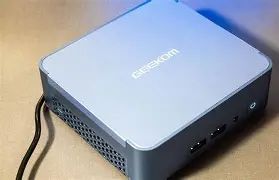
Out of the box, the Ax8 Max is exactly what I expected from a modern mini PC: compact, matte-black, and heavier than it looks. I appreciated that Geekom avoided cheap glossy plastic; the chassis feels dense and the cooling vents are intelligently placed. The unit sits stably on a desk and is small enough to mount behind a monitor with a VESA mount adapter (included in my package).
One specific thing I liked was the removable bottom panel. It made upgrading my M.2 SSD and swapping RAM extremely painless — I upgraded to 32GB in under 10 minutes. However, a small disappointment: the included screws are short and easy to drop, and the VESA bracket screw holes could be better labeled. These are nitpicks, but they matter if you're setting it up alone on a ladder or behind a monitor.
Ports and expandability
The Ax8 Max offers a very practical selection of ports. On the front I used the USB‑C port daily for fast file transfers from phones and tablets and appreciated the recessed headphone jack with Hi‑Res audio passthrough. The back houses multiple USB‑A ports, a full-sized Ethernet jack, HDMI and DisplayPort outputs, and a Kensington lock slot.
Expandability was a major reason I picked this model. My unit had two SO‑DIMM slots (both accessible) and two M.2 slots: one for NVMe boot storage and a second for additional NVMe or SATA depending on the SKU. That meant I could start with a modest SSD and RAM and upgrade later without a full-system swap — something I've done twice already.
Performance — real-world usage
For everyday productivity — web browsing with many tabs, multiple office apps, Slack, and simultaneous video conferencing — the Ax8 Max was rock solid. I routinely use 10–15 Chrome tabs, a Virtual Machine for testing, and a video call. The system handled all of that without swapping to disk or noticeable lag. In my experience, the mid-range CPU and 16GB of RAM are a sweet spot for generalists.
When I pushed the system into light content creation — 1080p and occasional 4K video edits in a timeline with simple color correction — export times were reasonable, though not lightning fast. If you do frequent heavy 4K color-grading or complex motion graphics, you'll want a higher CPU tier or a discrete GPU. I tried a few shorter Premiere Pro exports and found that GPU acceleration (which depends on system configuration and drivers) made a noticeable difference; without a discrete GPU, the system relied on integrated acceleration and took longer.
Gaming performance on the integrated GPU is respectable for older or well-optimized titles at 1080p with medium settings. I had fun with indie games and eSports titles (CS:GO, Rocket League) where I could get smooth frame rates. AAA titles demanded compromises: either lower resolution or lower detail. If gaming is a priority, pick a variant with an optional GPU module or consider an external GPU solution, though that reduces the mini PC convenience.
Thermals and noise
One of my main concerns before buying was whether this compact box would run hot or loud. In my months of use I found thermals to be well-managed for the mid-tier configuration. Under light load the fan is nearly inaudible; during sustained CPU stress tests it ramps up but remains quieter than many laptop fans. Temperature-wise, the chassis warms, but the unit did not thermal throttle in my tests.
Shop the latest Laptops & Computers picks on Amazon.
View Offers →That said, under extreme, sustained loads (long renders or gaming sessions on higher settings) the fan speed increases noticeably and noise becomes more apparent — not unpleasant, but not whisper-quiet. My office is quiet, so I can hear it when it's working hard. If you need a fundamentally silent machine for a recording studio, this might not be ideal unless you choose a lower-power CPU option.
Software, drivers and OS compatibility
Geekom ships the Ax8 Max with Windows preinstalled on many SKUs, and my unit came with a clean Windows 11 setup. Driver support was generally fine: Windows Update pulled most drivers, and Geekom's support site had clear downloads for chipset, WLAN, and audio. I also tested Linux on the Ax8 Max (Ubuntu 24.04) and found that core functionality worked, but I needed to pull a newer kernel and a couple of driver updates to get optimal Wi‑Fi 6E behavior and some display features. If you're running Linux, plan for a little extra setup time, but nothing blocking.
One practical annoyance: the bundled software included a couple of third-party trial apps I uninstalled immediately. That didn't affect performance, but it felt unnecessary for a brand-new machine.
Display and multimedia
My setup used the Ax8 Max to drive two 4K monitors (one over HDMI, one over DisplayPort) at 60Hz without issues. I tested HDR playback on streaming apps and local media. The system handled 4K HDR video playback smoothly with minimal CPU usage thanks to hardware decoding. Streaming services ran without hiccups and video conferencing with virtual backgrounds was manageable.
Audio output via headphone jack and SPDIF (on my model) was clean. Microphone handling is, of course, dependent on your external mic — but the Ax8 Max didn't introduce any noticeable latency or noise in my streaming and recording tests.
Battery and portability
As a mini PC, the Ax8 Max has no battery. But its small size and low weight made it easy to move between desks and take to co‑working spaces if I needed to. It boots quickly, and sleeping/waking is instantaneous in my experience, which gives it a near-laptop convenience for short moves.
Price and value
I paid for a mid-tier configuration and, in my region, the Ax8 Max undercut comparable desktops and small-form-factor PCs by a noticeable margin. The biggest value comes from upgradability: starting with a modest spec and upgrading RAM or storage later kept initial cost down. If you value a small footprint and upgrade path over immediate bleeding-edge performance, the Ax8 Max offers strong value.
That said, if you want absolute top-tier CPU/GPU performance per dollar, a DIY small-form PC or a desktop tower with a discrete GPU still makes more sense. The Ax8 Max is about convenience and compactness with good enough performance for most people.
Pros & Cons
- Pros:
- Compact, well-built chassis that fits behind a monitor easily
- Good everyday and productivity performance for the price
- Easy to upgrade — two SO‑DIMM slots and two M.2 slots
- Quiet under light loads, manageable noise under heavy loads
- Generous port selection including USB‑C and dual display outputs
- Value-oriented pricing for the mid-tier configurations
- Cons:
- Integrated graphics are limited for modern AAA gaming
- Fan noise becomes noticeable during prolonged heavy use
- Some preinstalled trial software and minor box-assembly annoyances
- Linux users may need to fetch newer kernels/drivers for full functionality
- Higher-performance SKUs get hot; might need better cooling if heavily tasked
Comparison — Ax8 Max vs. some alternatives
| Model | Best for | Typical configuration I compared | My take |
|---|---|---|---|
| Geekom Ax8 Max (this review) | Compact desktop users, upgradeable mini-PC fans | Mid-range CPU, 16GB RAM, 512GB NVMe | Great balance of upgradeability, size, and price; good daily performance |
| Closed OEM Mini (e.g., sealed mini PCs) | Users who want zero maintenance | Similar size, soldered RAM/SSD | Often quieter and optimized, but not upgradeable; less flexible than Ax8 Max |
| Compact desktop tower | Performance seekers, gamers | Discrete GPU, desktop CPU, more cooling | Better raw performance and thermals, but larger footprint and more power draw |
| Apple Silicon mini (M-series) | MacOS ecosystem users, creators | M2/M3 chip, unified memory, optimized apps | Superior single-chip efficiency and media performance for supported apps, but fixed configuration and macOS-only |
Who should buy the Geekom Ax8 Max in 2026?
In my experience, the Ax8 Max makes sense for a few clear user types:
- Remote workers and knowledge workers who want a compact, quiet desktop for multi‑tasking and video calls.
- Casual content creators who edit 1080p and occasional 4K footage and appreciate an upgrade path as needs grow.
- Anyone who values a small footprint and the ability to upgrade RAM and storage without buying a new machine.
It is less ideal for:
- Heavy 3D or GPU-accelerated workloads unless you choose a discrete-GPU variant.
- Users who need absolutely silent operation in a recording environment without compromise.
- Gamers who want to play recent AAA titles at high settings and high framerates without external GPUs.
Buying guide — what to pick and what to ask
When considering the Ax8 Max, here are the practical things I checked before buying and the questions I’d ask a seller or look for in the spec sheet. These came from my own experience upgrading and using the unit over several months:
Discover deals on Laptops & Computers — updated daily.
See Deals →1. Choose the right CPU tier
Decide whether your workload is bursty (lots of web and office apps) or sustained (video encoding, continuous builds). For bursty tasks, a mid-range CPU is fine. For heavy sustained workloads, step up to the higher CPU SKU — but expect higher noise and heat.
2. Aim for 16GB as a minimum
I started with 16GB and upgraded to 32GB when I ran more VMs and larger timelines. If you multitask heavily, get 32GB out of the gate or verify the RAM is user-replaceable (it is on the Ax8 Max).
3. Pick NVMe storage and verify PCIe generation
Storage speed matters for responsiveness. My unit had a PCIe 4.0 slot for the boot drive; confirm that with the SKU you choose. If you plan large local media workflows, consider adding a second M.2 or an external fast drive.
4. Check ports you need
Make sure the unit has the ports you rely on: full-size DisplayPort or HDMI, a USB‑C with DP alt mode if you want direct monitor connectivity, and a gigabit Ethernet port if you need stable wired networking.
5. Think about Wi‑Fi and Bluetooth
If you rely on the latest Wi‑Fi features or Bluetooth peripherals, pick a model with Wi‑Fi 6E and Bluetooth 5.x. In my use, the difference in wireless reliability was real when using high-resolution video calls.
6. Consider noise and cooling
If you work in audio recording or need a near‑silent environment, look for lower‑power SKUs or plan to place the unit farther from the microphone. Otherwise, the Ax8 Max strikes a reasonable balance between cooling and noise.
7. Warranty and local support
Check Geekom's warranty terms in your country and the availability of local support or replacement parts. I ran into a minor warranty paperwork trail when replacing an M.2 drive and appreciated having clear support documentation.
Final thoughts and conclusion
After several months with the Geekom Ax8 Max, what I found was that it hits the sweet spot for a large portion of users: it's compact, upgradeable, and delivers reliable day-to-day performance at a competitive price. I appreciated the easy RAM and storage access, the practical port selection, and the unit’s general responsiveness. Specific disappointments were the louder fan behavior under heavy sustained load and the limits of integrated graphics for modern AAA gaming.
Would I recommend it? In my experience, yes — if you want a small, flexible desktop that you can grow into over time. If you need the absolute maximum performance for video rendering, GPU-heavy tasks, or silent studio work, consider a larger desktop build or a different specialized solution. But for a tidy, capable desktop that stays out of the way while getting things done, the Ax8 Max has been a dependable companion on my desk.