The Ultimate Setup Guide for Your Box Thick Clicky Navy
For keyboard enthusiasts seeking a punchy, unapologetically clicky typing experience, the Box Thick Clicky Navy has become a popular choice. This guide walks through what the switch offers, how it behaves in real-world scenarios, and how to set it up for the best possible performance. It is written in an informative, editorial tone and aimed at readers who shop with practical priorities in mind — sound profile, feel, compatibility, modability, and daily use-cases.
Introduction: who should consider the Box Thick Clicky Navy?
The Box Thick Clicky Navy targets users who want an assertive, tactile, and audible click from every keystroke. It is commonly chosen by heavy typists, streamers and content creators who like a distinctive audio presence, and mechanical keyboard hobbyists building tactile-focused boards. Buyers typically select this kind of switch for its character rather than neutrality — it is a statement switch.
Before committing, users should consider the environment: clicky switches are loud compared to linear or silent tactile options. That loudness can be a feature in a private workspace, but a drawback in shared or quiet offices.
Product analysis: what defines the Box Thick Clicky Navy
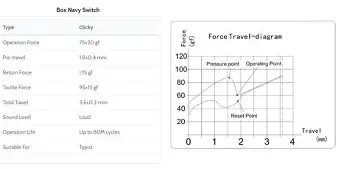
The Box Thick Clicky Navy is defined by a few key characteristics: a BOX-style housing for improved stem stability, a pronounced click mechanism that produces a sharp acoustic signature, and a heavier overall feel than many traditional "blue" clicky switches. The BOX design reduces wobble and provides a consistent stem alignment, which benefits both sound and feel across all switches in a set.
Sound profile: The Box Thick Clicky Navy is immediately recognizable when typing. The click is crisp and high in mid-to-high frequencies, with a strong transient (the initial "snap") followed by a shorter sustain than some hollow-sounding switches. Enthusiasts describe it as "tight" and "snappy" rather than "thocky" or "deep."
Feel and tactility: Tactile feedback is pronounced, with an unmistakable mechanical actuation that many typists find satisfying. The pre-travel and bump characteristics emphasize a deliberate actuation — the result is confidence in keystrokes and a reduced tendency to bottom out hard because the tactile event signals the keypress.
Build and durability: The box-style housing helps stabilize the stem and reduces inconsistent wobbles that can plague traditional two-piece housings. The switch is suitable for custom builds and often works well with a variety of plate materials and mounting styles. As with most mechanical switches, quality depends on manufacturer tolerances and batch variation, but users typically report a robust lifespan under normal use.
Compatibility and mounting
Box-style switches are compatible with standard MX keycaps and most PCBs and plates designed for MX stems. They work in both hot-swap and soldered PCBs and are commonly used in gasket-mount, tray-mount, and top/plate-mounted keyboards. The presence of a box housing makes them ideal for those who want to minimize stem wobble without resorting to heavy modding.
Modding potential
Enthusiasts can tailor the Box Thick Clicky Navy to taste. Common modifications include:
- Spring swapping — changing spring weight to adjust bottom-out force and actuation resistance.
- Lubrication — lightly lubing non-clicking parts (housing walls or spring) to reduce unwanted rattle; caution is required because lubricating the click mechanism itself can diminish the clickiness.
- Switch films — adding films to reduce shell wobble and sharpen sound.
- Plate/PCB selection — pairing with denser plates (aluminum, steel) will change acoustics compared to polycarbonate or FR4.
Real-world use cases
Understanding how this switch performs in everyday situations helps buyers decide if it fits their needs.
Typing and writing
For writers, programmers, and data-entry professionals who prefer audible feedback, the Box Thick Clicky Navy gives clear confirmation with each keystroke. The click reduces ambiguity, which can increase typing speed and accuracy for those who depend on auditory cues. It is particularly satisfying for those who enjoy a mechanical rhythm while composing long text.
Gaming
Gamers can use these switches, but they are not universally ideal. The heavier, more deliberate actuation and audible click can feel slower for rapid double-taps or fast twitch actions compared to lighter, linear switches. That said, some gamers like the clear feedback for single, deliberate actions (e.g., strategy or simulation games). Competitive FPS players often prefer lighter switches for reduced fatigue and faster repeat inputs.
Find top-rated Electronics products at great prices.
Browse Now →Streaming and content creation
Streamers and creators may appreciate the distinct audio character, which can become part of a channel's identity. However, loud keyboard clicks can be captured by microphones unless proper audio treatment (directional mics, noise gates, or isolation shields) is used. Many content creators either mic the keyboard intentionally for ASMR-style content or mitigate keyboard noise to keep the voice front-and-center.
Office and shared spaces
In shared environments, the Box Thick Clicky Navy can be disruptive. It is better suited to private offices or home setups. If a shared workspace is unavoidable, consider DIP-silent alternatives or use sound-dampening accessories like O-rings (which reduce travel and soften bottom-out) and desk mats to absorb sound.
Pros & Cons
- Pros:
- Distinctive, crisp click that provides clear auditory feedback
- Box-style housing reduces stem wobble for consistent feel
- Strong tactile enforcement—good for typing accuracy and confidence
- High modability (spring swaps, films, plate choices)
- Cons:
- Loud — not suited to quiet or shared environments without mitigation
- Heavier feel may lead to fatigue for long gaming sessions with rapid key presses
- Lubing must be done carefully to preserve the click mechanism
- May be polarizing: users either love the pronounced click or find it intrusive
Comparison table: Box Thick Clicky Navy vs. common clicky alternatives
| Feature | Box Thick Clicky Navy | Cherry MX Blue | Kailh BOX Jade |
|---|---|---|---|
| Sound character | Sharp, high-pitched, snappy click | Traditional click with longer sustain | Very clicky, slightly higher-pitched than MX Blue |
| Tactility | Pronounced tactile bump with deliberate actuation | Noticeable tactile click but lighter | Strong, tactile and very pronounced |
| Stability | Box housing reduces wobble | Standard two-piece housing with more stem play | Box-style, stable stem |
| Modding friendliness | Good — films, springs, plate choices | Good — widely supported, many variants | Good — similar modding options to other BOX switches |
| Best for | Typists and hobbyists who want a bold click | Users seeking a classic clicky feel with wide availability | Enthusiasts who want a very snappy click with box stability |
Practical setup and tuning: step-by-step recommendations
To extract the best performance from Box Thick Clicky Navy switches, consider the following setup and tuning workflow. This keeps the click integrity while improving sound and feel.
1. Test before you commit
If possible, try a switch sample or a hot-swap test board. Typing a few hundred words will reveal whether the weight, click, and sound match expectations. Online reviews and sound tests help, but first-hand testing is ideal.
2. Choose the right keyboard platform
Decide whether the board will be plate-mounted, gasket-mounted, or tray-mounted. Plate material significantly affects acoustics: metal plates emphasize higher frequencies and sustain, while polycarbonate typically softens and adds warmth. For the Box Thick Clicky Navy, a slightly less resonant platform (e.g., polycarbonate or FR4) can temper brightness without dying the click.
3. Stabilizer preparation
Good stabilizers make a dramatic difference for larger keys. Clip and lube stabilizers to reduce rattle. Even small stabilizer noises can clash with the clicky profile and make the typing sound messy.
4. Films and spring swaps
Install switch films to tighten the housing fit and reduce shell buzz. If the switch is heavier than desired, consider lighter springs; if it needs more heft, heavier springs will increase resistance and change bottom-out behavior. Remember that swapping springs and adding films will alter the character slightly, so adjust to taste.
5. Lubrication strategy
Lubing the Box Thick Clicky Navy requires restraint: heavy lubing of the click mechanism will mute the click. Most modders apply a thin, careful coat to the spring and housing walls while avoiding the click leaf or components that generate the audible click. Test after a small batch to ensure the click remains satisfying.
6. Sound dampening and desk setup
A dense desk mat, rubber feet, and foam layers under the PCB reduce unpleasant echoes and amplify the desirable transient click. For streamers, microphone placement and gating can keep keyboard audio pleasant to listeners.
Buying guide: what to prioritize
Buyers often weigh a set of priorities against personal preferences. The following checklist helps make an informed choice.
1. Sound vs. feel
Decide whether sound or tactile feel is more important. If sound is primary, evaluate recorded sound tests and note how the click sits in the frequency spectrum. If feel is primary, focus on actuation characteristics and try sample typing if possible.
Find top-rated Electronics products at great prices.
Browse Now →2. Environment
Consider where the keyboard will be used. Quiet shared spaces suggest choosing a silent or dampened switch. Home offices and private studios are ideal environments for Box Thick Clicky Navy switches.
3. Compatibility
Ensure the target PCB accepts MX-style switches and determine if hot-swap compatibility is required. Hot-swap PCBs make experimentation simple, reducing the cost and risk of committing to a switch type.
4. Modding willingness
Ask whether the buyer wants to mod. If yes, budget for films, springs, stabilizers, and lubricants. If no, choose a board whose plate and case materials pair well out of the box to minimize post-purchase work.
5. Quantity and longevity
Buyers building a full custom board should buy a full 70/75/84/96-key set, accounting for extra keys or spare switches for experimentation. Check the vendor’s reputation for consistency across batches.
Maintenance and long-term care
Switches are low-maintenance, but a few practices prolong their life and preserve sound quality:
- Keep the keyboard clean — dust and debris can affect click mechanisms.
- Avoid lubricating the click mechanism unless intentionally experimenting.
- Store spare switches in anti-static bags and a dry place to prevent corrosion.
- Periodically check stabilizers and re-lube if rattles develop over time.
Common buyer questions
Will these switches be too loud for office use?
They are louder than most switches and may be distracting in a shared office. Acoustic mitigation (O-rings, desk mats, or an enclosure) helps but may not be sufficient for very quiet environments.
Can they be silenced without losing click?
Minor dampening (O-rings, foam) reduces bottom-out noise and echo, but the primary click will remain noticeable. Aggressively silencing the switch risks losing the defining click entirely.
Are they suitable for fast typing and gaming?
Excellent for deliberate, accurate typing. For extremely fast, repetitive gaming, some players prefer lighter linears, but many users are comfortable gaming on heavier clickies depending on game type and play style.
Conclusion
The Box Thick Clicky Navy is a strong, characterful switch aimed at enthusiasts who value a bold tactile and auditory experience. It excels in private workspaces, creative studios, and custom builds where sound and feel are part of the keyboard’s personality. With mindful setup — the right plate, careful use of films and springs, and restrained lubrication — it can deliver a satisfying and consistent typing experience that reinforces accuracy and enjoyment. For buyers who prioritize subtlety or operate in shared quieter spaces, quieter alternatives may be more appropriate, but for those who welcome a clicky signature, the Box Thick Clicky Navy remains a compelling option.